Why Does Silicon Dioxide Have High Melting Point
Silicon has a very high melting point due to its giant covalent structure. The large structures the metal oxides and silicon dioxide have high melting and boiling points because a large amount of energy is needed to break the strong bonds ionic or covalent operating in three dimensions.

Properties Of Giant Covalent Molecules Macromolecules
Silicon has a very high melting point due to its giant covalent structure.
. The higher the melting point the more stable is the compound. Since covalent bonds require more energy to overcome than van der waals SiO2 requires a higher temperature than SO3 to melt thus SiO2 has a higher melting point. Silicon Dioxide has a macromoleculargiant covalent structure which means it has covalent bonds between all atoms in its structure.
This is due to the strength of Si-O-Si binds in the lattice. Pure silicon has an infinite melting point but most materials of biological origin have melting points that range from room temperature to over 1000 degrees Celsius 1800 F. Melting and boiling points.
Why does silicon dioxide have such a high melting point. This means that it forms thousands of covalent bonds between its silicon and oxygen subunits. Melting and boiling points of these oxides are much lower than those of the metal oxides or silicon dioxide.
Why does silicon dioxide have a high melting point. Also why does phosphorus oxide have a low melting point. Simply so why does silicon have a higher melting point than sodium.
The oxides of phosphorus sulphur and chlorine consist of individual molecules - some small and simple. Other substances are added to silicon dioxide to make glass. The large structures the metal oxides and silicon dioxide have high melting and boiling points because a large amount of energy is needed to break the strong bonds ionic or covalent operating in three dimensions.
Sulfur Trioxide has a simple molecular structure meaning it has Van der Waals forces between molecules. A lot of energy is needed to break the strong covalent bonds throughout the structure. Covalent bonds are much stronger than Van der Waals forces and so require much more energy to overcome and this leads to the.
Also Know why does silicon have a higher melting point than phosphorus. Covalent bonds stronger in SiO2 than in SiCl4 so more energy isneeded to break bonds. Because the silicon and oxygen atoms are held by strong intermolecular forces.
Since Diamonds contain more covalent bond than Silicon Dioxide and these bonds requires heatenergy to break Diamond has a higher melting point than Silicon dioxide. Silicon dioxide is suitable for lining furnaces because of itsvery high melting point of 1600 to 1725 degrees celcius. Silicon has a very high melting point due to its giant covalent structure.
Silicon dioxide has a giant molecular structure with strong covalent bonds resulting in a high melting point. Both diamond and graphite have a giant molecular structure. Thus the melting temperature of silicon is higher as it exists as a giant covalent structure so strong covalent bonds have to be broken in order to melt it whereas phosphorus exists as a simple covalent structure so weaker London forces have to broken in order to melt it.
It is sohigh because of. Since covalent bonds require more energy to overcome than van der waals SiO2 requires a higher temperature to melt. The large structures the metal oxides and silicon dioxide have high melting and boiling points because a large amount of energy is needed to break the strong bonds ionic or covalent operating in three dimensions.
A lot of energy is needed to break the strong covalent bonds throughout the structure. Silicon dioxide SiO2 has a macromolecular structure. What you can safely say is that because the metallic oxides and silicon dioxide have giant structures the melting and boiling points are all high.
The molecular oxides Phosphorus sulfur and chlorine form molecular oxides. 1 The melting point of the elements going across the Periodic Table from sodium to argon A increases steadily. Melting and boiling points.
Explain why silicon dioxide has a high melting point above 1600ºC whereas carbon dioxide is a gas at room temp and pressure. Why does silicon dioxide have such a high melting point. A lot of energy is needed to break the strong covalent bonds throughout the structure.
A Silicon dioxide has a very high melting point. Glass melts at a lower temperature than silicon dioxide. Why does silicon dioxide have a high melting point.
Why does silicon dioxide have such a high melting point. The giant structures the metal oxides and silicon dioxide will have high melting and boiling points because a lot of energy is needed to break the strong bonds ionic or covalent operating in three dimensions. Glass is made from silicon dioxide.
Why do diamond and graphite both have high melting points. Why does silicon dioxide have a high melting point. Melting and boiling points.
Silicon dioxide doesnt have any mobile electrons or ions so it doesnt conduct electricity either as a solid or a liquid. Carbon dioxide contains individual molecules of carbon dioxide held together by weak intermolecular forces. Melting and boiling points.
SiO2 has a high melting point. The carbon atoms are held together by strong covalent bonds which. The large structures the metal oxides and silicon dioxide have high melting and boiling points because a large amount of energy is needed to break the strong bonds.
SiO2 has higher melting point. The intermolecular forces binding one molecule to its neighbors are van der Waals dispersion forces or dipole-dipole.
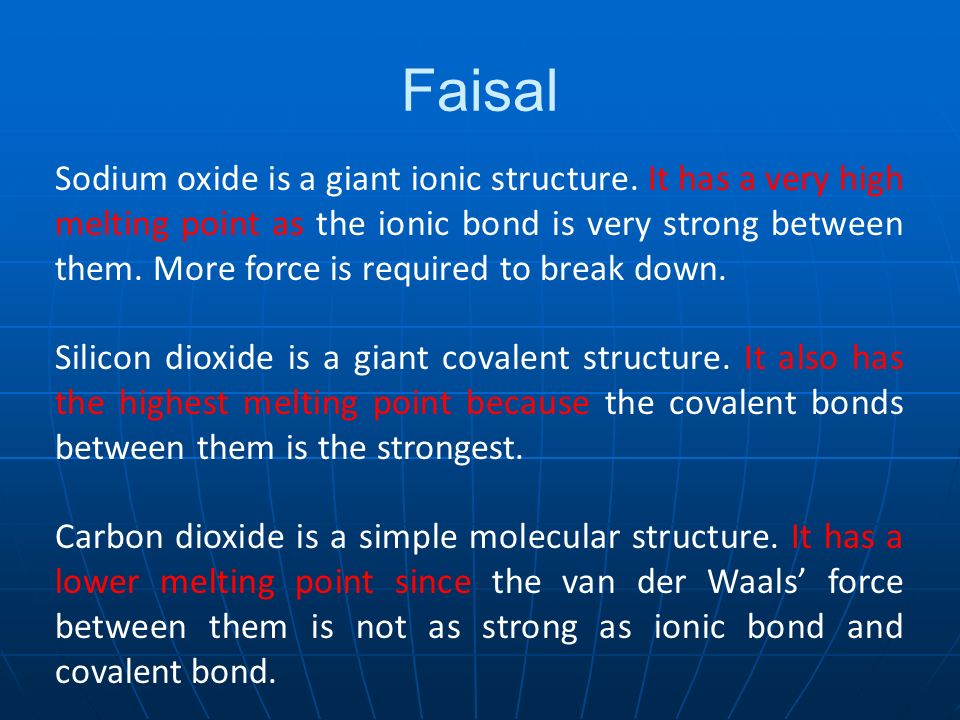
Based On Their Structures Explain Why Sodium Oxide Silicon Dioxide And Carbon Dioxide Have Different Melting Points Here Are 6 Real Student Answers Ppt Download

Why Is Carbon Dioxide A Gas While Silicon Dioxide A Solid Quora

22 2 The Oxides Of Elements In Period 3 Flashcards Quizlet


Comments
Post a Comment